Movement, Landscape, and Collective Resilience
Resilience doesn’t just live in people. It lives in places, in pathways, and in the structures that hold and move us.
My work explores three layers present in any living system — whether that’s a nervous system, a community, a lineage, or a landscape:
Place — the ground that holds experience and stores memory.
Route — the pathways through which energy, emotion, information, or people move.
Structure — the forms, boundaries, roles, and built systems that organise life.
Each layer learns in its own way. Real change happens when they shift together.
In a person, that might look like:
• Feeling safer internally (place)
• Emotional energy moving more freely (route)
• Boundaries and behaviours reorganising (structure)
In a community:
• Culture shifts (place)
• Communication patterns change (route)
• Policies or roles evolve (structure)
In ancestral repair:
• The emotional field becomes more spacious (place)
• Old trauma pathways loosen (route)
• New relational patterns take shape (structure)
When these layers reinforce one another, change becomes architectural rather than merely cognitive.
I’m interested in how systems respond under load — how they tighten, reroute, or reorganise — and what new intelligence becomes available when they do.
How I Work
This enquiry began with a simple question: Do places carry meaning?
Place names such as Eyewell in the Malvern landscape opened a deeper exploration of story and encoded memory. That curiosity led to journeys across South and Central America, including engagement with Earth chakra traditions, and a year spent walking the symbolic terrain of the Glastonbury Zodiac.
More recently, my work has focused on the Somerset Levels — particularly the engineering intelligence of the Bleadon Sluice — and on megalithic structures such as Arthur’s Stone. These sites revealed strong parallels with the human nervous system: how we hold, channel, regulate, and stabilise under pressure.
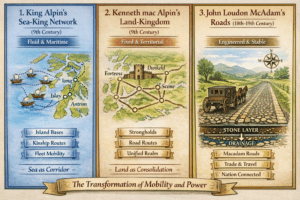
A companion enquiry into my paternal McAdam lineage traces Alpin maritime crossings and inland corridors — from Belfast along the Antrim Coast toward Kintyre, Islay, and Mull — exploring how engineered routes, glens, and later macadamised roads have shaped systems thinking across generations.
Book review – Thinking in Systems
This is not about fixed historical claims. It’s about relational listening — to land, to infrastructure, and to the inherited patterns through which resilience takes form.