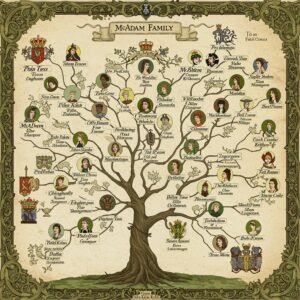
Ancestral mapping and repair explore how patterns from previous generations continue to shape our present lives — and how those patterns can be transformed with awareness, compassion, and choice. This work is not about blaming those who came before us. It is about understanding the emotional, relational, and nervous system inheritance we carry and discerning what we wish to continue and what we are ready to release.
When we look with curiosity rather than judgement, both strengths and wounds come into view. What has been carried unconsciously can become a source of clarity, grounding, and direction.
Mapping: Seeing the Lineage Pattern
Mapping is the process of making inherited dynamics visible. It brings into focus the threads that run through a family line — the ones we repeat without realising, and the ones we have been quietly resisting for years.
This often includes:
• Identifying repeating themes — abandonment, migration, secrecy, financial instability, trauma, silence, emotional suppression, or fixed family roles such as caretaker, scapegoat, or peacekeeper. Naming these patterns softens their unconscious authority.
• Understanding emotional inheritance — families pass down coping strategies, beliefs about safety and love, attachment styles, and nervous system responses, even when the stories themselves are incomplete or unspoken.
• Locating the pattern in your lived experience — recurring relationship dynamics, emotional triggers, bodily sensations, or chronic stress responses often carry ancestral threads. Mapping connects the dots between “then” and “now.”
Mapping is not about excavating every detail of the past. It is about recognising the shape of what has been handed down.
Repair: Transforming the Lineage Pattern
Repair is where insight becomes movement. It is the slow, embodied work of shifting what has been inherited so that it no longer shapes the future in the same way.
Repair may include:
• Releasing what does not belong to you — recognising that a pattern began before you, and that you are not required to carry it forward.
• Completing unfinished emotional cycles — offering acknowledgement, grief, or symbolic restoration where something was silenced, cut short, or left unresolved.
• Changing the trajectory through embodied choice — each time you set a boundary, regulate differently, or choose a new relational behaviour, you alter not only your own life but the emotional direction of the lineage.
• Integrating new patterns — repair becomes real when change is lived through nervous system regulation, new relational habits, and sustainable behavioural shifts.
My own work has shown how these processes unfold across generations.
• The Scapegoat and the Battlefield traces how the legacy of Sedgemoor shaped a family line.
• A Crossing explores how we may rely on an ancestral pattern nearly 300 years later.
• Three Cousins follows the survival strategies that became ancestral memory.
• The Herd looks at how these patterns can be transformed.
This framework is interpretive and non-clinical. It complements, but does not replace, therapeutic or medical care.
How I Work
My approach weaves together:
• genealogical and historical enquiry
• pattern recognition across generations
• somatic and energetic awareness
• dowsing where appropriate
• referral to therapeutic support when needed
My own ancestral enquiry has included research into the Battle of Sedgemoor and the transportation of Monmouth rebels to the Caribbean, as well as defining events in my paternal lineage surrounding John Loudon McAdam, and likely clan MacGregor, and the Dál Riata Kings. These threads have deepened my understanding of how present-day patterns are often rooted in events that are far older than living memory.
This work is a crossing: between past and present, seen and unseen, inherited and chosen.
Collaboration & Referrals
I am on the Professional Register of the British Society of Dowsers and offer ancestral mapping and repair as part of my broader transition-facilitation practice.
If your work engages with lineage, inherited trauma, migration history, or systemic healing, I welcome connection and collaboration.
For upcoming workshops and events, please visit the Events page or use the contact page to get in touch. You can also subscribe to my Substack, Jenny’s Sin Eater Stories, for reflections on ancestral healing.