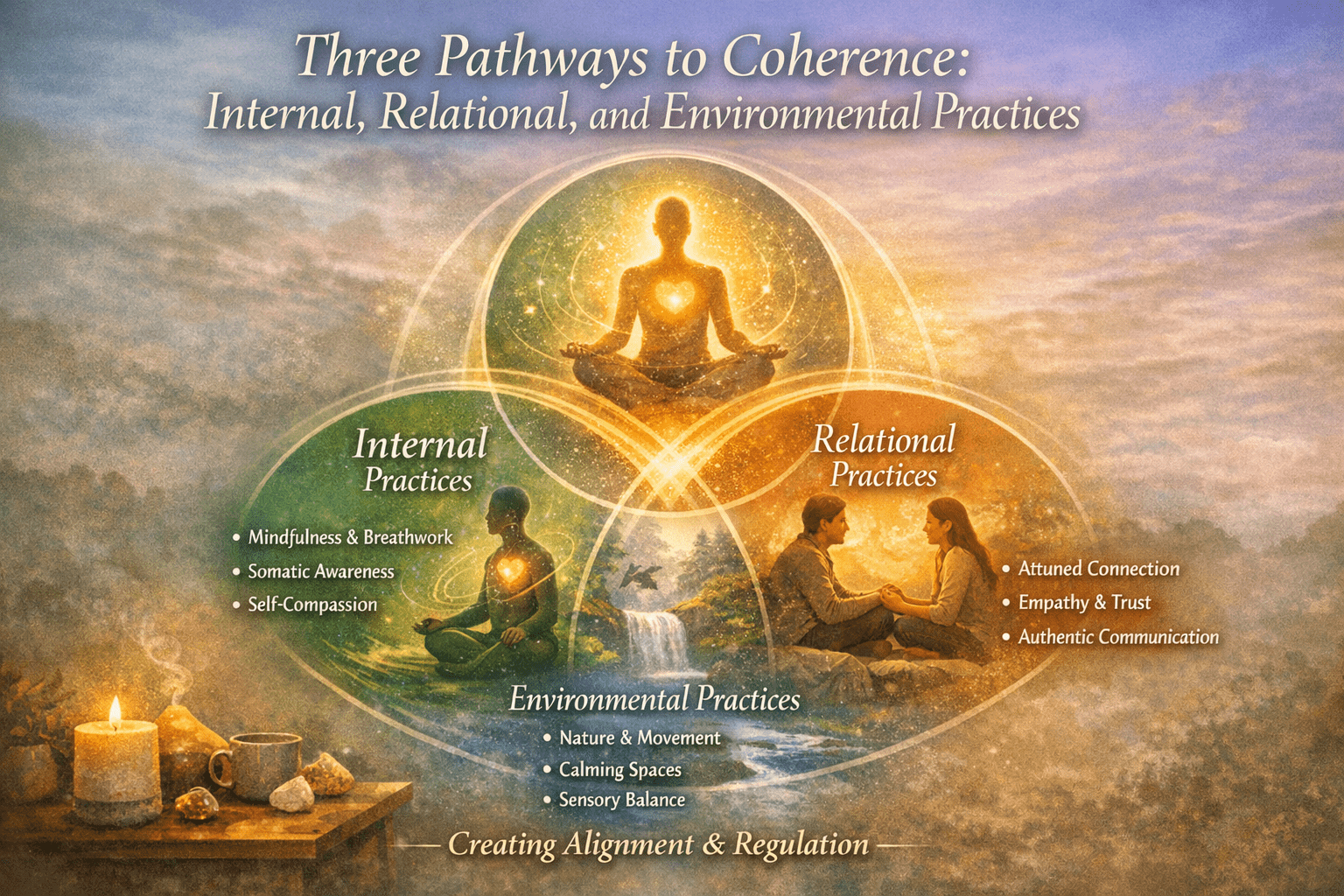
There is a kind of influence that has nothing to do with persuasion.
It does not rely on charisma, perfect language, status, or performance. It cannot be forced through strategy or manufactured through image management.
You recognise it instantly when you encounter it: someone walks into a room, and the atmosphere changes. Conversations soften. People slow down. Tension dissolves without explanation.
Not because that person demanded attention — but because they embodied a state others could feel.
“You become it — model it. You become the experience. Transmit a frequency. People just calm in your presence.”
At first glance, this sounds mystical. But beneath the poetic language is something deeply human: our nervous systems are constantly communicating with one another.
Long before words are consciously processed, people read tone, pace, posture, breathing, facial tension, eye movements, emotional steadiness, and attention. Human beings are profoundly sensitive to the internal state of others. We feel safe before we analyse it. We sense agitation before it is spoken.
A dysregulated person can spread anxiety through an entire room without saying a sentence. In the same way, a calm and grounded person can stabilise the emotional atmosphere simply by being fully present.
The Language of the Nervous System
Psychology gives several names to this phenomenon:
emotional contagion
co-regulation
mirror neuron theory
social attunement
Different frameworks describe different mechanisms, but they all point toward the same reality: internal states are contagious.
This is why people often trust your energy before they trust your words.
If someone tells you to relax while they themselves are tense, rushed, and emotionally fragmented, your nervous system notices the contradiction immediately.
But when a person speaks slowly, listens deeply, and responds without hidden urgency, others unconsciously begin syncing to that rhythm.
Their presence becomes an anchor.
Presence as Communication
This is why certain therapists, teachers, spiritual leaders, artists, coaches, and even close friends can feel unusually calming to be around.
Often it is not what they say that changes people most. It is the state from which they speak.
Modelling is stronger than instruction. The deepest communication is embodiment.
To “become the experience” means cultivating internally what you hope others will feel externally. It means moving beyond performance and into coherence.
If you want people to feel trust, become trustworthy in your behaviour and tone. If you want depth, learn how to slow down enough to truly perceive another person. If you want peace, stop performing peace aesthetically and develop actual steadiness within yourself.
People are remarkably sensitive to authenticity — not perfectly, but enough.
Eventually, everyone can feel the difference between cultivated presence and controlled image management.
The Spaciousness of Being Present
Presence itself alters the experience of time.
When someone is truly present, they are not rushing to fill silence. They are not mentally rehearsing their next response while pretending to listen. They are not trying to dominate the interaction or extract validation from it.
There is spaciousness around them.
And spaciousness is calming because it removes pressure.
In a world addicted to speed, performance, reaction, and stimulation, genuine presence feels rare. Many people cannot remember the last time they were with someone who was fully there.
This is part of why contemplative practitioners often affect people so deeply. Whether through meditation, prayer, discipline, or self-awareness, they have trained themselves to stop constantly scattering their attention.
Their calm is not cosmetic. It is practised.
Vibration, Energy, and Coherence
Some interpret this psychologically. Others interpret it spiritually.
In spiritual traditions, this idea is often described as vibration, consciousness, energy, aura, or frequency.
Buddhism may frame it as compassionate presence. Taoism may describe it as alignment with the Tao. Christian mysticism may call it grace or peace. Modern spiritual language often speaks in terms of energetic resonance.
The terminology changes. The observable effect does not.
Certain people make others feel safer, clearer, slower, and more grounded.
Not because they are performing serenity, but because they have become less internally divided.
What Creates This Kind of Presence
That kind of presence is rarely built through external optimisation alone. More often, it emerges from:
emotional regulation
deep listening
reduced ego-reactivity
comfort with silence
self-awareness
grounded body awareness
consistency
compassion without performance
absence of hidden aggression
And perhaps most importantly, it cannot be convincingly faked for long.
Eventually, the nervous system reveals the truth beneath the image.
Coherence as Influence
This is why the most powerful form of influence may not be persuasion at all.
It may be coherence.
A state where your words, nervous system, attention, actions, and intentions are aligned closely enough that people feel something real in your presence.
The message is no longer something you are trying to deliver.